(888) 977-1520


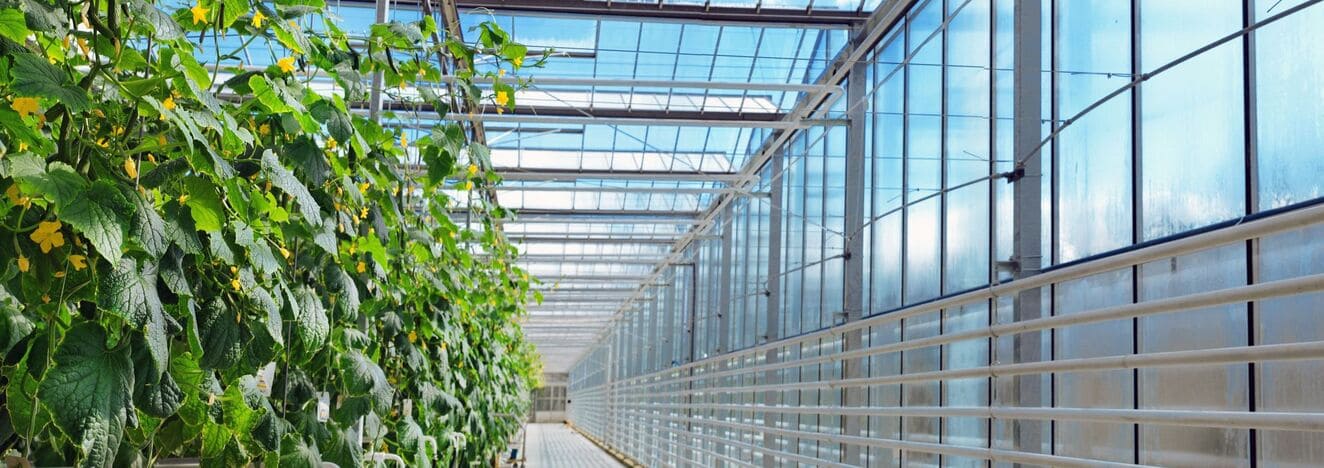
Vapor Pressure Deficit (VPD) is defined as the difference (deficit) between the amount of moisture in the air (humidity) and how much moisture the air can hold when it is saturated. The amount of moisture at saturation is the maximum amount of moisture the air can hold at its current temperature before condensation occurs. This point at which moisture condenses is called the dew point, and it is at a complete saturation level (100%).
VPD is calculated by subtracting the actual moisture in the air from the maximum possible humidity:
VPD = Vapor Pressure at Saturation – Actual Vapor Pressure
While Relative Humidity (RH) is a good general indicator, VPD is a valuable tool for understanding greenhouse climate conditions. This is because it connects the air’s moisture to the plant’s physiological processes. Additionally, VPD can be used to evaluate the following factors:
- Plant transpiration rate
- Disease threat: High humidity combined with low temperatures (low VPD) drastically increases the risk of fungal infections.
- Condensation potential
- Irrigation needs of greenhouse crops
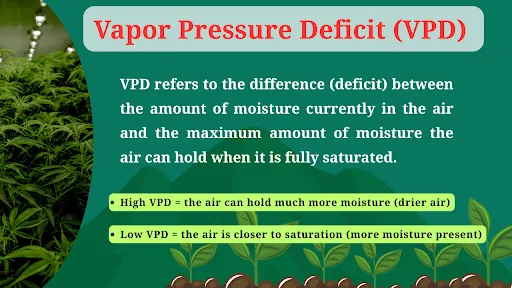
Furthermore, if the humidity is too high or too low, the plants struggle to transpire and grow properly. To combat this, VPD management should be done to balance the ideal humidity level. The method of achieving this ideal humidity level in greenhouses is by using dehumidifiers. They efficiently remove greenhouse moisture and keep VPD at optimal levels. This process adjusts the balance of water in the air and greenhouse surfaces.
Having an ideal vapor pressure deficit (VPD) range is essential for healthy plant growth. Problems with incorrect VPD levels can cause poor plant health and reduced yield. A summary of common issues associated with incorrect VPD levels and their corresponding solutions is provided below.
Ideal Vapor Pressure Deficit (VPD) ranges for greenhouse crops
The recommended vapor pressure deficit (VPD) range for most plants is between 0.4 kPa and 1.6 kPa. However, the optimal VPD value depends on the growth stage and the crop variety. The following chart outlines general recommendations, but actual optimal VPD levels depend heavily on plant species, growth stage, greenhouse design, leaf temperature, and light intensity.
|
Crop Stage |
Recommended VPD Range (kPa) |
Physiological Goal |
|
Propagation/ Seedlings |
0.4- 0.8 kPa |
|
|
Vegetative Growth |
0.8- 1.2 kPa |
|
|
Flowering or Fruiting |
1.2-1.6 kPa |
|
Table 01: Ideal VPD for each crop stage
Ideal VPD range for Cannabis
Cannabis plants require a more precise range of VPD to guarantee optimal quality and maximum yield. For the vegetative phase, the ideal range is between 0.8kPa and 1.0kPa. This range is recommended to promote vigorous, healthy growth without causing stress to the plants. Once flowering begins, VPD should gradually be increased to 1.2kPa – 1.5 kPa. Higher VPD helps dense buds release moisture more efficiently while minimizing the risk of mold or rot.
What does high VPD mean?
A high VPD indicates dry air with a strong ability to pull moisture from leaves. High VPD levels naturally occur during hot days, dry season, or times of intense light.
A high VPD level can lead to many downsides, which can harmfully affect the crops. The major downside is that plants start to transpire rapidly. This can lead to excessive water loss in plants. Additionally, leaves may curl or wilt in the presence of high VPD levels. This occurs when the roots cannot supply enough water to the plant, leading to drought stress. Furthermore, high nutrient uptake due to high VPD poses a greater stress risk to the plants. Finally, growth may be hindered due to the water-pressure imbalance caused by high VPD levels.
When the above issues occur, several steps can be taken to correct them. First, lower the greenhouse temperature to reduce evaporation. Next, increase humidity using a dedicated humidifier or a misting system. It is also important to keep the soil consistently moist to support water uptake. Finally, adjust irrigation frequency to prevent plant dehydration.
What does low VPD mean?
A low VPD means the air is very humid. A very high humidity indicates that the air is close to the saturation level (100%). The issue of low VPD usually occurs when the humidity is high and the temperature is low.
When compared with the high VPD situation, a low VPD instance is potentially worse. There are several drawbacks associated with low VPD levels. Most importantly, plants are unable to release moisture effectively, which leads to reduced transpiration. Also, the nutrient uptake in plants reduces, and condensation may form on leaves. Additionally, there is also a high disease risk due to low VPD levels. Especially, fungal infections can thrive in these environmental conditions.
When these problems arise, the following steps can help mitigate their negative effects. The first step is to boost air circulation and ventilation. This is essential for maintaining healthy airflow in the grow room. It helps to prevent stagnant air and reduces excess moisture. Secondly, increasing the temperature to the ideal range supports proper plant transpiration and keeps environmental conditions stable. In this situation, dehumidification also becomes an essential part of the greenhouse. Dehumidifiers can reduce humidity and restore a healthy moisture level. It ensures the overall climate stays balanced for optimal plant growth.
How to measure VPD
The VPD can be calculated by taking the difference between the water vapor pressure at a certain temperature and the vapor pressure that would be found in saturated air at the same temperature. The example below illustrates how VPD can be calculated using a simple equation.
Example:
At 25 °C and 60% RH, the actual vapor pressure is:
- Saturation vapor pressure at 25 °C: 3.17 kPa
- Actual vapor pressure = 60% of 3.17 kPa = 1.90 kPa
If RH were 100% at the same temperature, the vapor pressure would reach full saturation:
- Saturated vapor pressure = 3.17 kPa
The difference between saturation and actual water content is the VPD:
VPD = 3.17kPa – 1.90kPa = 1.27kPa
As shown above, the actual vapor pressure can be calculated using the RH and the saturation vapor pressure at the given temperature. The saturation vapor pressure at any temperature can be found using a psychrometric chart calculator. There are many free calculators available online, such as the one provided by Psychroid.
Management of greenhouse VPD
In a greenhouse, water constantly evaporates from plants, pots, soil, and trays, causing humidity to rise and VPD to fall. To counter these fluctuations, it is important to maintain optimal VPD levels through external control. Growers must manage both humidity and air circulation to ensure stable, ideal VPD conditions. Several methods can be used to manage VPD inside greenhouses.
Dehumidification
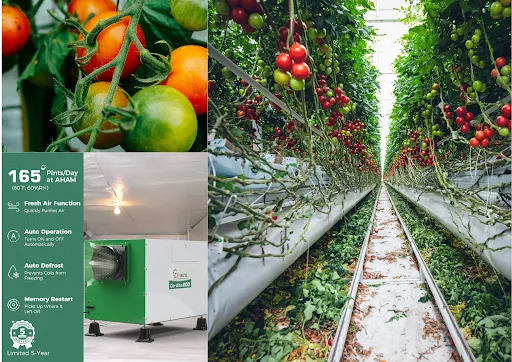
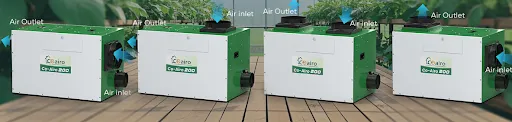
Growers use dehumidifiers to manage optimal conditions. Dehumidifiers physically remove water from the air, which lowers humidity and increases VPD. Doing so will prevent condensation and fungal growth. For growers who struggle with high humidity, mold risk, or inconsistent VPD levels, adding Coairo dehumidifiers is often the simplest way to improve plant health and yield. For dehumidification, highly performing and efficient dehumidifiers should be used. The industry standard is to use reliable equipment, such as CoAiro 165-PPD, which efficiently removes water content with state-of-the-art technology.
Air circulation and ventilation
Another important factor affecting the VPD level in indoor growrooms and greenhouses is proper air circulation. It is essential for maintaining stable VPD levels. Proper air circulation helps plants transpire normally and reduces the risk of fungal infections. Farmers utilize exhaust fans, circulation fans, and intake vents to ensure proper ventilation and maintain the proper balance of humidity and temperature.
Temperature control
Temperature changes directly affect VPD. Keeping a stable temperature using heaters, cooling, or ventilation prevents stress. It also helps to keep plant growth consistent.
Conclusion
Vapor Pressure Deficit (VPD) is a strong measure to assess the plant stress, water balance, and overall greenhouse climate health. VPD connects humidity, temperature, and plant physiology and forms a single measurable factor. This helps growers to make informed decisions about their greenhouses and growrooms. Maintaining an ideal VPD range ensures balanced transpiration, efficient nutrient uptake, healthy growth, and maximum yields.
Effective VPD management can be done through dehumidifiers, humidifiers, ventilation, or advanced climate systems. This is essential for achieving consistent crop quality and healthy plants. Indoor growers are able to create a stable and productive environment by understanding how VPD works and applying the correct tools to control it.